Transcendence

“Transcendence” is popularly equated with that which is “above the ordinary” or even “above the material world” – within the realm of the Divine.  Transcendence is often closely linked with what we think of as “spiritual”.  And “spiritual people” are commonly expected to  have transcended/risen above all worldly concerns, needs or desires – sometimes literally sitting on a remote mountain top or heavenly cloud.  Our own lives, in comparison, can seem hopelessly mired in the mundane!

The Latin root of the word “transcendence”, however, points less to a remote permanent destination than to a  journey into the heart of the present moment.   Rather than being distracted and disheartened by the mundane, in those moments we find our spirits renewed and our hearts opened to the forces that create and uphold all of life.

While countless rituals and objects have been devised to help create such blissful experiences, they can happen anywhere and at anytime.  The challenge when they do happen is to allow these experiences to transform us, informing our actions (rather than causing us to focus on recreating the experience).

Direct experience of transcending mystery and wonder” is one of the many sources from which Unitarian Universalists draw.  In fact, it’s the first of six listed.  It is recognized as something affirmed in all cultures: an experience of reality that, however briefly, moves and changes us.

The American Transcendentalist movement of the 19th century, which helped shape Unitarian Universalism as it is today, promoted the idea that divinity is to be found not above, but within the material, natural world.

Take a walk through the woods or along a beach, look closely at a seashell or child’s hand, and you are likely to sense that there is far more to this forest, this ocean, shell, or hand than is visible to the eye!  The idea might even come to you that the distinctions between them are mere illusion.

That feeling of oneness can be utterly intoxicating. But it’s what happens “next” that defines you as a spiritual being.

Posted in spirituality, unitarian universalism | Tagged | Comments Off on Transcendence

Welcoming Spring

As the season of Spring transforms the earth, we explore the universal yearning for and promise of personal and societal transformation.

We honor the religious stories and rituals of the season that transform fear into love, ignorance and arrogance into wisdom, greed into generosity, despair into hope.  We look for and celebrate the return of green to the hillsides, of birdsong to the morning skies, and the lingering colors of delayed dusk.

These annual changes are a joy to the heart; a reminder  of the mysterious complexity and creative resiliency of the natural world.

As metaphors, these changes urge humanity to trust that beneath the cold, dark seasons of life lie many seeds preparing to transform the landscape of our future. More often than not those seeds were planted by hands other than our own.  And so it is with gratitude that we think of those who came before, seeking to walk tenderly through the garden of their vision and to plant our own seeds.

Posted in current events, spirituality, worship resource | Tagged , , , , | Comments Off on Welcoming Spring

Remembering What’s Most Important

I read recently that the average human being uses less than 10% of his/her brain’s potential, and needs constant stimulation in order to even stay at that low level.  I’m not one for Sudoko or other types of games designed to strengthen the cerebral muscle, but my vocation apparently does keep it well toned (well enough to notice that by the end of summer leave I’m much less inclined to use fancy words and phrases, like:  “responsible discernment” and “sustainable visionary fiscal planning”.

During the church year I do a lot of reading and meet a lot of people whose names and stories I strive to remember.  At any given moment, while scanning supermarket shelves for example, I’ll be making connections between a poem I half-remember and a quote I once heard, a sermon I’ve been meaning to write, a friend I need to call, an obscure Reformation-era heretic, the fact that the dogs need a bath, how much I love trail-mix and hate that I can never remember my passwords.

In between all of that I’ll get visual memory flashes of the cemetery I played in as a child, an unexpected smile someone flashed in my direction while I was stopped at a red light, and a favorite sweater I haven’t seen lately.  Generally I leave the supermarket with something like soft-white lightbulbs, instead of the eggs and gluten-free cereal I came in for.

There’s so much to think about, so much to remember.

In order to maintain a greater sense of control over those things I really do have to remember from day to day, I make lists ensuring that I move the car on Wednesdays so I won’t get another ticket, make that appointment with the dentist, and remember to bring the piñata to church for Sunday’s children’s lesson on “sin”.   With these coping mechanisms in place I end up being fairly efficiently, surprising myself (and often others) with how much I manage to get done from day to day and week to week!

But there’s more to life than remembering to do those things that bring the satisfaction of efficiency, isn’t there?  There are other things to remember:  like breathing deeply; noticing beauty; relishing relationships; and trusting one’s inner knowing.  Somehow those things always ended up on the bottom of those lists, displaced by more “urgent” matters.

Until, that is, I entered them in my cellphone calendar.  Now, every day at 9 am, the phone chimes and reminds me to “breathe deeply”.  At 11 it let’s me know that I am “held in love”, and at 3 it reminds me that “now is the time to celebrate joy”.

Each time I hear that chime while in the midst of the day’s busy-ness, I reach for the phone expecting a new email message to which I have to respond.  And each time I am surprised anew to find something different – a call to presence and joy.

Posted in current events, spirituality, unitarian universalism | Tagged , , | Comments Off on Remembering What’s Most Important

Street-Side Affirmation

20120315-221519.jpg

Tagged , | Comments Off on Street-Side Affirmation

Grace

Grace is something for which we prepare ourselves. It is the guest we invite and for whom we clean house. It is the guest whose anticipated arrival causes us to see the everyday of our lives with new eyes; it inspires us to mend that which is worn and adorn our rooms with well-placed flowers and a candle or two. We ready ourselves, and wait.

This waiting, I think, is a prayer; a recognition that our survival depends upon being ready to say: “Come in – I’m so glad you are here”.

Tagged , , , | Comments Off on Grace

Vision is Essential!

Henry David Thoreau, 19th century Transcendentalist Unitarian, is quoted as having said that “the question is not what you look at, but what you see.”  I’ve known people who looked at a forest and saw only mud, wood and leaves.  Meanwhile, others saw not only the miraculous interrelationships between soil, air, sun, water and time – but a trail of footprints belonging to their own unborn descendents.  Vision is essential!  

What do you see?

Vision is essential as we join together in support of liberal religious values and community.  It expands our sense not only of what is possible, but of what we can and should joyfully offer up in the name of that possibility!

Comments Off on Vision is Essential!

Time Traveling

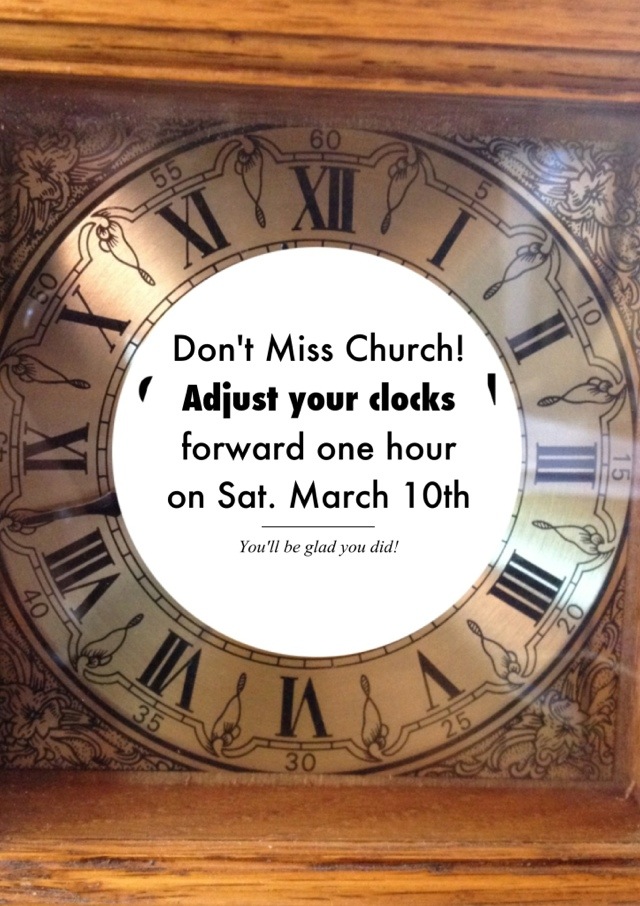
20120308-144705.jpg

Posted in current events, worship resource | Tagged , | Comments Off on Time Traveling

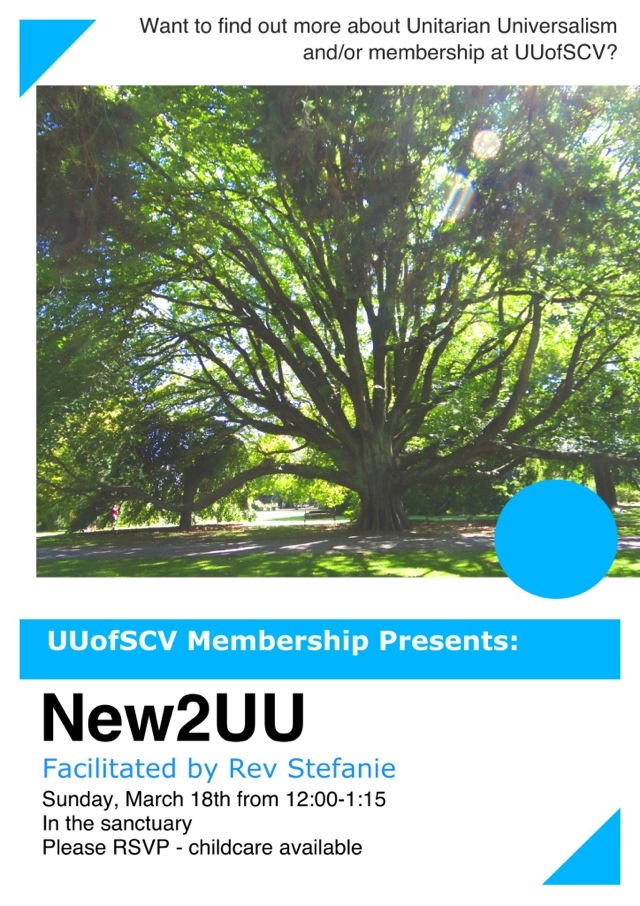
New2UU

20120307-092504.jpg

Posted in unitarian universalism | Tagged , | Comments Off on New2UU

20120305-220848.jpg

Discernment, balanced presence, patience – and a willingness to let go. Lesson learned!

Posted in hope, spirituality | Comments Off on

On Brokenness (excerpt from 03/05/12 “Speaking of Sin” sermon)

It is the nature of cities to “break”, buildings and bridges to tumble and fall, glass to shatter.  It is the nature of social, political and economic systems to splinter in the wake of such or other events (whether natural or man-made).  It is the nature of human beings to find themselves, as a result, tending broken hearts and damaged dreams – as they cling to fragments/shards of hope. 

These are the realities that came to mind most immediately, as I thought about this month’s congregational theme of “brokenness” (ironically, while vacationing in New Zealand:  a country, whose mountain ranges grow each year as the force of shifting tectonic plates breaks through the earth above; a country still reeling from the earthquake that took the lives of 185 people last year, breaking the hearts of thousands still struggling to put together the broken pieces of their lives).

Walking along the perimeter of the broken inner-city zone (where temporary shops are now set up in cargo containers), I couldn’t help but notice that human history is also marked by tremendous resiliency, creativity, an urge to heal, to lift up and strive for wholeness/for unshakeable “perfection”! 

We do have a tendency to pick ourselves up when we fall, don’t we?  …dust ourselves off, “loose the cords” of whatever binds us, and try to get back on track!  Try to “put the pieces back together – even better this time!”  

It is this aspirational aspect of the human animal that most sets us apart from the other creatures with whom we share this planet.  It is this aspect of ours that gave and gives rise to culture and civilization, art and science, generation upon generation.  It is our ability to imagine, to envision wholeness, to envision “perfection”, that spurs us on, isn’t it?!

Often, yes!  And that’s what Unitarian Universalism focuses on: that which is best within us and among us, whether realized or as a potential reality.  But the other part of the human story has to do with how hard it is for us, as individuals and as societies, despite best intentions, despite resolutions, despite laws, commandments, parables, covenants, promises and even threats, to live up to those “ideals of perfection”.

At some point or other, if we’re going to be honest with ourselves, we find ourselves “falling short”,  “breaking” from the ideal.  Not living up to the fullness of who we are, or can be.  We find ourselves giving in to what Plato called “our universal human frailty”/our evil, rebellious “titanic” nature (which always seems to bump up against, to temp, the “Dionysian spark”/the Divinity/the goodness within). 

This dualistic perspective on human nature is not shared by all religious traditions, but it is a huge part of the religious traditions from which Unitarian Universalism sprang.  It’s also a big part of our shared cultural heritage as Americans tuned into Tom & Jerry cartoons: watching the struggle between the little angel and the little devil sitting on Tom’s shoulders; noticing how often the little devil convinces him to do the “wrong thing”.  To Sin.

We know what “wrong” is when we see it or do it: whether that wrong is defined by a break from God’s will, from societal contracts, or from our own highest visions for what is possible.  We have a pretty good sense of what NOT to do.  Even as children.  Even as we yearn for “something better”:  for the sweet rewards of a life well lived, that ongoing whacks at life’s “many pointed piñata” is expected to rain upon us!

So why talk about that here, on Sunday morning?  Why bring up the loaded topic of “sin”?  The thing is, as much as Unitarian Universalists don’t talk about sin, we often treat the topic itself, as if it were a sin – especially when it comes to focusing on the personal: the ways in which we, as individuals, might be going astray.  (My observation is that we’d much rather talk about the sins of corporations, of media, of past presidents and distant countries!) 

And I think that’s a shame for a whole bunch of reasons.  First of all, because no topic should be off-limits here, if it can shed light on human experience and responsibility.  

Secondly, because recognition of humanity’s “brokenness”:  of our tendency to forget who we are (whether in relation to God, or the “unfolding of the cosmos”, have been at the heart of philosophical and religious inquiry for as far back as we can tell.  

Our ancestors knew that it is in the nature of all things, bound within time, to “break”.  It is the nature of mountains to rise up through the sea, breaking apart the blue expanse that was!  And for those same mountains, over millennia, to break apart, to crumble into sand. 

It is the nature of human beings also to “break”:  not only physically, as life, as time and gravity take their toll.  But spiritually, as well, every step of the way.  Ethically and morally.  And it makes sense to me, to just “own that”.  To acknowledge that to one another now and then. 

Why?  Because if we don’t, we’re likely to feel like we’re the only ones who don’t always get it right! And, because we’re likely to be looking in the wrong places for answers to why our families, our schools, our governments and eco-systems are breaking apart, crumbling at the rate and to the extent that they are…


Posted in current events, hope, unitarian universalism, worship resource | Tagged , , | Comments Off on On Brokenness (excerpt from 03/05/12 “Speaking of Sin” sermon)