WINTER HOLIDAY POEM

Each year, this time, we gather round, in darkness to behold

The miracle of love we find,within, when it grows cold!

We lift up stories, songs and such, passed down from long ago

Discovering there, reminders of, the truths, that help us grow!

The miracles of Chanukah, of Yule-time fires shared,

Of Jesus born amidst the straw, deserve to be declared!

So as you move into the day, and Winter’s darkest hour,

Commit to hope, commit to love, as life’s most precious power!

(The Rev. Stefanie Etzbach-Dale, 2010)

Comments Off on WINTER HOLIDAY POEM

The First Night of Chanukah

BELIEVING IN ENOUGH

“There is not enough”, he shouted,

His voice echoing against the sacred stones

that had once housed his God,

and which were to be made a welcome place, once again.

“The oil is not enough .  It will last but one night”

He poured it into vessels of clay, careful not to spill a drop.

“It burns well enough now, but what of tomorrow?”

He spat in frustration and anger – embarrassment, too, perhaps.

He had hoped for there to be so much more.

And the flames sputtered and flickered throughout that night

and into the next, and the one beyond that,

until the shadows of eight nights had been vanquished,

along with his doubt.

(Rev. Stefanie Etzbach-Dale – Chanukah, December 1, 2010)

Tagged | Comments Off on The First Night of Chanukah

Heart Killing

At the end of yet another productive day filled with back-to-back appointments and errands, a day during which many of the tasks on that rotating to-do list were acknowledged and re-prioritized, I laid my body to rest and found that it could not.

I lay awake, calculating so intensely the next day’s efficiency, that I did not hear the advance and retreat of waves on the dark sand below my window.

I got up to look; to assure myself.

It was during that movement among the shadows of my home that a long-forgotten moment surfaced among those other thoughts.  It was the discovery, years ago, when I most needed it, of a Chinese translation for the word ”busy” – rendered through two characters representing “heart” and “killing”.

Averse to sloth, back then I had prided myself on making the best possible use of my time; staying busy.  As a result, I had stopped feeling the dance of life’s waves on the shores of my heart, and knew its edges to have become cold.   Efficiency had been killing my heart’s receptivity.

The accidental discovery of that translation set about a surge of gratitude, compassion and forgiveness, and a determination to protect the gift of heart.

And so I did, until I fell into busy-ness once again and, at the end of that most recent productive day, strained to hear and celebrate what had been there all along.

It was the desire to hear that released my thoughts, and brought rest.

Imagine that.

Comments Off on Heart Killing

On Identity

The question at the core of our individual collective dilemma is clearly:  who am I, and how am I to be in the world?

It’s not one we ever answer to our full satisfaction since who we are as individuals and as co-creators of the world is constantly changing!

This week I’m preparing a lesson for the group I lead at StepUp, focusing on the complexity of our unique identities, the tendency to want to “categorize” people, and the pain and confusion that is so often caused when we do that (when we make assumptions about people and don’t take the time to allow them to reveal themselves to us).

Participants will be encouraged to think about how they “self-identify” by reflecting upon some of the most common categories (see below) and sharing their experiences.

  • Age or age group
  • Appearance (Ex: 5’5”, brown hair, green eyes,stocky build, etc.)
  • Gender or gender identification
  • Sexual Orientation (Ex: heterosexual, homosexual, bisexual, asexual, etc.)
  • Physical Health or ability
  • Mental Health or ability
  • Social or Economic Status
  • Occupation, activities & interests (What you “do)
  • Ethnicity (your connection with others in a particular cultural group)
  • Nationality (Country of Citizenship)
  • Worldview & Values (Ex: political, spiritual, cultural, etc.)
  • Relational Identity (Ex: parent, brother, sister, niece, friend, neighbor, etc.)
  • Locality (The place with which you most identify – ex: Where you were born, lived, or now live, etc.

What aspects of your identity do you recognize, claim and celebrate?


Comments Off on On Identity

Both Private & Public

On Sunday, 10/10/10 I had the honor of officiating the wedding of my nephew and his partner – in the Botanical Gardens overlooking Sydney Harbor, in Australia.

There had been rain and blustery winds in the days prior, prompting quite a bit of concern regarding a “Plan B” for the location. But that morning the sun came out in all its glory, as did the couple’s family and friends (from all over the world). As anticipated, ninety festively attired guests gathered on the lush lawn to bear witness to and support the loving union of these men.

Joining them, one-by-one and somewhat less festively attired, where the passersby – those out for a Sunday morning stroll or jog, who stopped in surprise when they noticed “no bride”.  By the time vows and rings and embraces had been exchanged, the number of witnesses had almost doubled.  As had the the palpable presence of awe and wonder and celebration.

That morning two lives and families joined together.  And that is surely gift enough!

And yet, it was the still presence of those strangers, straining to hear every word spoken and to take in every detail of that unexpected scene, which bears such poignancy for me.

I know that Jason and Robie will live good, meaningful, loving lives. But it is the presence of those “others” I find myself remembering and celebrating; those slowing growing smiles and cheers; that look of finally understanding the breadth of love.


Comments Off on Both Private & Public

Reflections on Identity and the Post-Modern Age

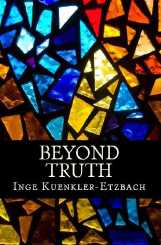
by Inge Kuenkler-Etzbach, Introduction by Rev. Stefanie Etzbach-Dale

Summer 2010 I edited  “Beyond Truth”, a new book by Inge Kuenkler-Etzbach (now available on Amazon).  As it turned out, her life’s journey and my own, although very different, resulted in some surprisingly similar perspectives about the nature of reality and the challenges and opportunities of our postmodern age.

Below is the introduction I wrote for that book.

Things aren’t like they used to be.  My parents came of age at a time when the authority of the Church was surpassed only by the power-lust of the State.  Neither were questioned and individual identities were formed (for good or ill) within and through these simultaneously violent and sheltering contexts.

My own children are growing up in a world in which authority is routinely questioned and seamlessly rejected.   Too much is known of the fallibility and corruptions of Church and State.

In their world the guiding influences, the agents of power and authority, are largely invisible: cloaked in well-established marketing ploys designed to sell the unnecessary to the underpaid; or shielded by self-proclaimed “righteousness” of one deadly sort or another.

Today too much is known, and yet not enough.  So many often unpredictable and seemingly senseless influences affect the formation of personal identity and moral clarity.

And while this generational shift can be interpreted as frightening evidence of the utter randomness of existence, and/or an underlying moral void in the universe, or even an apocalyptic inevitability, it actually gives me “hope”.

It gives me hope because it means that we no longer have to be blind followers of tradition.  It gives me hope because we no longer have to be mute servants of systemic injustice.  We are becoming, by necessity, on guard: awakening to one another’s pain, sensing our responsibility and encouraging cooperative risk-taking.

Our identities are growing.  We are beginning to recognize ourselves and one another as so much more than we may have thought:  as healers, teachers, builders and stewards of history.

Today we are empowered and guided not by Church or State, not by Market or Ideology, but by that which animates and unites each one of us:  the Spirit of Life!

The time in which we now live, as confusing and dangerous as it may seem and often actually is, empowers us to step from under the shadow of authority as we have long known it.

It asks us to be guided instead by the light of truth – to be found within.

This is no easy task when you’re used to looking elsewhere, if you’re bound by fear, or seek perfection in uniformity.  There are no easy formulas or shortcuts.  It takes courage.  And it is essential to be curious about and welcoming of the perspectives of others; to be mutually committed to sharing and building upon accumulated insights in the service of love and compassion.

The challenges inherent in this task are many, yet they give me cause for hopefulness.  They support an understanding of the primacy of our relationships with one another, of the need to foster transformational trust and goodwill.

More so, they lift up our potential to serve as beacons to one another.  This, so that no matter how bleak things may seem today, they won’t ever revert to: “how they used to be.”

Posted in hope, post modernism, unitarian universalism | Tagged | Comments Off on Reflections on Identity and the Post-Modern Age

PSWIRL 2010: Workshop Series

Comments Off on PSWIRL 2010: Workshop Series

LOCAL PRESS: The Apocalypse

The following question and response were submitted to and printed in the In Theory section of the Burbank Leader,  Vally Sun and Glendale News Press:

Most scripture promotes our careful stewardship of the earth. And yet, apocalyptic religious traditions welcome signs of the “end times” (such as environmental degradation, war, oil spills, etc.), considering it the fulfillment of long-awaited prophecy and the beginning of a new age of peace.    What’s the role of free will in the face of such prophecy?  Should we celebrate these “signs” or try to do something to minimize the violence and destruction? If action is called for, how should we rally together to battle our “compassion fatigue” and heal the world’s wounds?

Given the speed of modern communications technology and the ratings-focused output of news media it is hard not to feel that calamities of all sorts are on the rise.

While earthquakes, fires and storms have always battered the earth and humans have a long and bloody history of poverty, disease and warfare, we are much more likely these days to be confronted with evidence of their destructive power than we would have 100 years ago.

However, with the rise of global economic systems, we are also much more likely to be not only beneficiaries of, but also victims of uncapped greed and corruption – thereby becoming more than mere “witnesses” to unfolding events.  Examples abound, not only in Louisiana.

We are becoming aware, if nothing else, of the ramifications of our insensitivity to the responsibility we bear one another as inhabitants of the earth.

While in the past it may have been possible to read into calamitous events “the will of God” (whether as warning or punishment or for some other mysterious reason), it is becoming increasingly clear (to religious and secular communities) that our individual and collective choices have influenced the world/the future in horrendous ways.

Free will got us in this mess and, I believe, free will is going to have to get us out of it.

If nothing else, celebrating the destruction of this earth or the idea of a “selective salvation” of its inhabitants discounts the precious gift of Life (contributing to suffering and raising real concerns about theologies justifying these things.)

Unitarian Universalists may not be united in their perspectives on God’s will.  But they are united in affirmation of the relationship between our freedom as human beings, and our responsibility to care for one another, the earth, and its creatures.

While compassion fatigue is always a threat (given human limitation and the wounds of the world), freedom allows us to choose with care and integrity the ways in which we each  support the freedoms of others.

Comments Off on LOCAL PRESS: The Apocalypse

LOCAL PRESS: Celibacy & Clergy Sexual Abuse

The following was written in response to a question posted by the In Theory section of the Valley Sun, Glendale News-Press and Burbank Leader regarding connections between clergy sexual abuse and celibacy.  Do you believe celibacy is the root cause, or could there exist other causes that haven’t been addressed yet?

My understanding of sexual abuse is that it has less to do with desire for sexual contact (whether heterosexual or homosexual) than it does with desire to exert power.

Whenever and wherever sexual abuse occurs, it is a travesty.  When it is enacted upon the youngest, most vulnerable among us, by those entrusted with the care of their souls, it is particularly abhorrent.

I do recognize that celibacy can (when freely chosen) be a valid life choice and/or a vital spiritual practice.

However, I do not consider it necessary in living a spiritual life.  In fact, it removes those who take such vows from grappling with some of the most beautiful and complex of human experiences and relationships – thereby inhibiting one natural avenue toward spiritual growth.

Nor, as indicated, do I believe that celibacy is a “root cause” of sexual abuse.

If hunger for power is indeed at the root of sexual abuse, then all institutions (not just those identifying as religious) would be well served to examine their power/authority structures; to define and insist upon healthy boundaries, rigorous standards of safety and systems of accountability.

Unitarian Universalism, as a covenanted faith, is built upon creating and nurturing environments that are physically, emotionally, and spiritually safe for all – to encourage mutual freedom for each person’s spiritual journey.

Along those lines most of our congregations are actively involved in “Safe Congregation” programs providing:  covenants and codes of ethics; clear procedures, policies and workshops in order to explore the complex social issues of interpersonal violence and abuse; safety and risk management assessment tools; comprehensive sexuality education curricula; and responsible staffing tools.

While these programs do not guarantee that the “unthinkable” will never happen, they do serve as constant reminders of our individual value, worth, and mutual responsibility.

Comments Off on LOCAL PRESS: Celibacy & Clergy Sexual Abuse

LOCAL PRESS: Spirituality & Religion

The following is in response to a question posed by the In Theory section of the local press regarding concerns about the growing trend to identify as “spiritual but not religious”.

Religions are distinguished as paths upon which one may encounter the Transcendent – that which greater than we (by whatever name it may be called).

Each religious path is paved with it’s own unique history, songs, values, prayers, rites of passage and rituals believed to facilitate such encounters, which are considered to be “spiritual” in nature.

For many the religious path and spiritual journey are one and the same.  But for those who have been excluded from their religious path or otherwise hurt by religion, who object to the proven or potential corruptions within religion, the spiritual journey may involve studying/walking the roadmap of many religions, or of secular wisdom; it may involve forging one’s own path.

Since encountering the Transcendent tends to inspire service to humanity and all of creation those walking the path of religion are often well situated, if/when that actually happens, to join forces with those on the same path – in ways that foster accountability, are socially/environmentally necessary, deeply meaningful, and personally transformational.

Those walking self-chosen paths and fortunate enough to meet the Transcendent upon them can and usually do choose to do likewise.  But, it may take a little more work to identify how and with whom to best put their spiritual insights into action.

Unitarian Universalism’s solution is to be a religion offering and encouraging a diverse range of paths for the spiritual journey.  As well as many, many vital opportunities for service to that which is larger than we.

It is not uncommon to hear that such shared service is precisely where the Transcendent is discovered!

Tagged , , | Comments Off on LOCAL PRESS: Spirituality & Religion